
How to Choose the Right Wooden Spice Box for an Indian Kitchen
Choose a wooden spice box by the spices you actually use, compartment count, kitchen space, refill habits and everyday access — not simply by size.
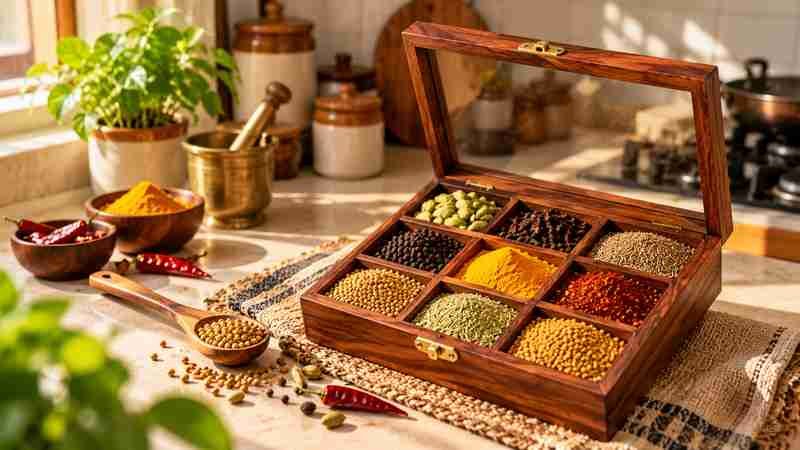
For most Indian kitchens, the best wooden spice box is the one that comfortably holds the spices you use most often without taking up unnecessary counter or cabinet space. Start with your daily masala routine, then choose the compartment count, box size and lid style that make cooking and refilling easy.
1. Start with the spices you use every day
Before buying a spice box, make a simple list of the masalas you reach for most. Common everyday choices may include turmeric, chilli powder, coriander powder, cumin, garam masala, mustard seeds or other regional favourites. The right box should match your cooking routine rather than forcing you to fill every compartment.
If you regularly cook different cuisines, leave some room for spices that change with your meals. A little spare capacity can be more useful than a box that is completely full from day one.
2. Choose the compartment count around your routine
Compartment count is one of the most practical decisions. A smaller box can work well for a compact spice collection or a kitchen where only a few masalas are used daily. A larger compartment set makes more sense when you cook frequently and want several spices within easy reach.
Count your genuinely frequent-use spices first. Then choose the nearest useful size rather than buying a larger box simply because it has more compartments.
3. Think about where the box will live
Measure the shelf, drawer or countertop area where you plan to keep it. A beautiful wooden spice box is less useful if the lid cannot open comfortably or the box has to be moved every time you cook.
For a small Indian kitchen, accessibility matters just as much as capacity. Keep the box close to the main cooking area, but away from direct steam, splashing water and prolonged moisture.
4. Consider refill frequency
Think about how often you replenish spices. If you cook every day, a box that holds practical working quantities can reduce constant refilling. If you use certain spices only occasionally, storing smaller quantities may help preserve freshness and reduce waste.
For powdered spices, clean and completely dry compartments are especially important. Do not put damp spoons or wet spices into a wooden container.
5. Choose a design that is easy to use and maintain
A spice box should make cooking easier. Look for a stable wooden build, a lid that is easy to handle and compartments that are simple to access. Natural wood also needs sensible care: avoid soaking it, wipe spills promptly and allow it to remain dry.
If you are comparing wooden spice boxes online, check the actual dimensions, compartment arrangement and product photographs rather than judging only by the number of compartments.
6. Wooden vs other spice-storage options
Wooden spice boxes can add warmth and a handcrafted feel to an Indian kitchen, while glass or metal containers may be preferred for certain storage situations. There is no single material that is perfect for every kitchen. The better choice depends on how often you cook, how you store spices and how much you value natural material and traditional presentation.
7. What to avoid
- Choosing a box only because it has the highest compartment count.
- Ignoring the available shelf or countertop space.
- Storing wet spices or using a wet spoon inside the box.
- Keeping wooden storage permanently exposed to steam or water.
- Buying without checking dimensions and compartment layout.
How to choose quickly: a simple decision
Small spice collection? Choose a compact box. Many daily spices? Choose more compartments. Small kitchen? Prioritize footprint and easy access. Frequent cooking? Prioritize practical capacity and quick refilling. Traditional kitchen aesthetic? A handcrafted wooden spice box can combine storage with visual warmth.
Explore wooden spice boxes from LEVASTO
If you want to compare handcrafted wooden spice boxes designed for Indian kitchens, explore the LEVASTO wooden spice box collection and compare the available compartment layouts and sizes.
Frequently Asked Questions
How many compartments should a wooden spice box have? Choose according to the spices you use regularly. The best compartment count is the one that fits your routine without unnecessary empty or unused sections.
Is a wooden spice box suitable for an Indian kitchen? Yes, provided it is kept dry and protected from prolonged steam and moisture.
Should I buy a large spice box for future use? Only if you genuinely expect to use the additional compartments.
Where should I keep a wooden spice box? Keep it somewhere convenient for cooking but away from direct steam, splashing water and wet countertops.
The right wooden spice box is not necessarily the biggest one. Choose it around your real spice collection, daily cooking habits, available kitchen space and maintenance routine. When those four things match, spice storage becomes simpler, faster and more enjoyable.